A Health Savings Account is a tax-advantaged account which allows you to pay for your eligible out-of-pocket health care costs using pre-tax dollars.
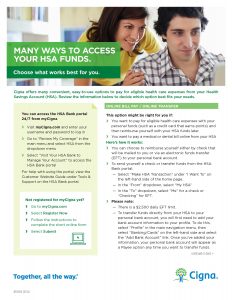
You’re offered a Health Savings Account (HSA) through HSA Bank (myCIGNA.com) if you select the Standard HSA or Enhanced HSA medical plans. You can use your account to pay for health expenses in the current year or roll it over for use in the future.
Allows for pre-tax dollars to be set aside for qualified out-of-pocket health care expenses like deductibles and coinsurance.
Contributions, earnings, and withdrawals used to pay current and future qualified health care expenses are not subject to federal and most states’ taxation.
Your Health Savings Account rolls over each year and the funds go with you wherever you go, even if you leave the company.
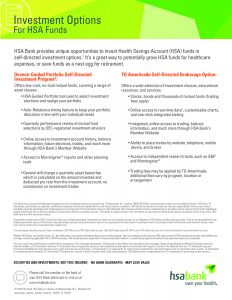
Once you have $1,000 in your account you can invest your funds. Find out more through HSA Bank.
You have a couple of ways to contribute to your HSA. You can make pre-tax contributions through payroll deductions. You can also make after-tax contributions directly to HSA Bank (myCIGNA.com). You can change your Health Savings Account payroll deduction election at any time through Dayforce.
If you live in California or New Jersey, HSA contributions are subject to state tax. Please consult your tax professional for more information.
HSA Employer Contribution:
Employees in either the Standard or Enhanced HSA Medical plan are eligible for an Employer Contribution to their HSA account by getting their annual physical. There is no extra paperwork for you. CIGNA provides a report to The CBX Solutions Group monthly based on the claims filed in the previous month. It can take up to 2 months after your physical to see your Employer Contribution added to your account, depending on when the claim is filed by your physician.
Coverage for:
Employer Contribution
Employee Only
$600
Employee and Dependents
$1,200
The IRS sets the annual limit for contributions to an HSA:
The annual 2026 IRS contribution limits are $4,400 for individual coverage and $8,750 for family coverage.
If you are age 55 or older, you can contribute up to an additional $1,000.
The annual limit includes contributions from the wellness credit. If you plan to participate in the wellness program and want to contribute the maximum to your HSA account, please deduct the wellness contribution amount from your contribution amount.
Eligibility Requirements:
The Health Savings Account is a tax-advantaged account, so there are IRS rules about who can participate. You are not eligible to contribute to a Health Savings Account if:
You’re also covered by another health insurance plan that isn’t an HSA-eligible health plan; such as a spouse’s or parent’s medical plan or health care flexible spending account;
You’re enrolled in Medicare (Part A or B), receiving Social Security benefits, or claimed as a dependent on another person’s tax return;
You’re on active military duty or a veteran who received veteran’s benefits within the last three months.
Enrolling in the Standard HSA or Enhanced HSA Plan is your affirmation that you are eligible to contribute to a Health Savings Account. If you’re unsure if you qualify, talk to a tax advisor or consult IRS Publication 969 for more details.